By the Fly Shiny team · Updated July 2026 · From the team behind 1,000+ Cirrus washes alongside a Cirrus Service Center
Quick answer: To clean a Cirrus Vision Jet (SF50), start with the belly and landing gear — remove oil, grease, and hydraulic fluid with Fly Shiny Oil Delete — then remove exhaust soot with Carbon Blitz where the top-mounted engine actually deposits it: the aft fuselage and V-tail. Clean bugs with enzyme-based Bug Blitz, dry wash the whole airframe with Quick Turn, then neutralize every surface you cleaned. Protect the composite airframe with Static Guard every 3 to 6 months.
That's the short version. Below is the full process — and where the Vision Jet breaks the rules you learned on every other aircraft.
SF50 Cleaning at a Glance
| Contaminant | Product | Where on the Vision Jet | Why it's safe |
|---|---|---|---|
| Oil, grease, hydraulic fluid | Fly Shiny Oil Delete | Belly, gear wells, gear legs | Non-flammable, composite- and paint-safe, won't soften paint |
| Exhaust soot | Fly Shiny Carbon Blitz | Aft upper fuselage, tailcone, V-tail | No hydrogen embrittlement, won't corrode or etch paint |
| Bugs | Fly Shiny Bug Blitz | Leading edges, nose, windshield | Enzyme-based — attacks the bug, not the aircraft; safe on all surfaces including acrylic |
| Everything else | Fly Shiny Quick Turn | Entire airframe | Waterless dry wash that lubricates as it cleans and neutralizes cleaner residue |
| Protection | Fly Shiny Static Guard | Airframe + acrylic windows (never glass) | Anti-static wax — reduces the static that pulls dust onto composite airframes |
Why Is Cleaning a Vision Jet Different From Other Jets?
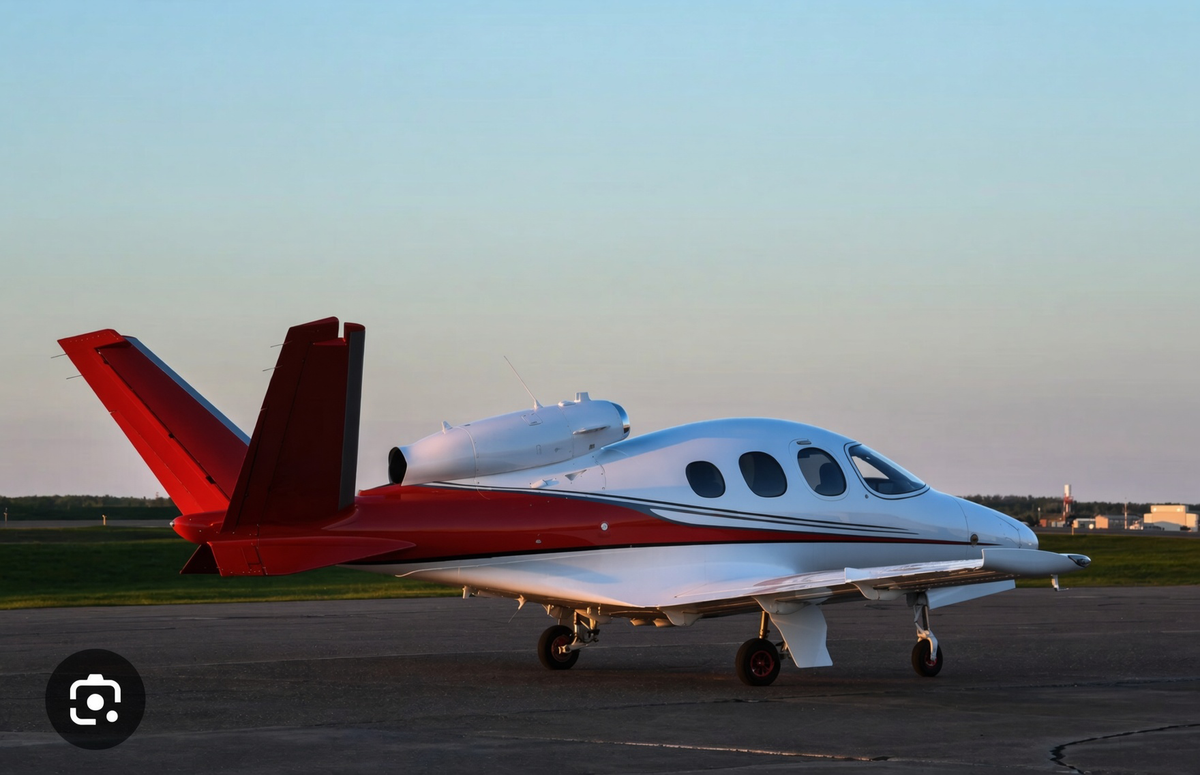
The SF50 doesn't look like other jets, and it doesn't get dirty like them either. The single Williams FJ33 turbofan sits on top of the aft fuselage, so exhaust soot deposits where most detailers never think to look: across the aft deck, the tailcone, and up the V-tail — not just the belly. The airframe is carbon composite, which builds static charge and pulls hangar dust back onto surfaces you just cleaned. The gear retracts, so instead of wheel pants you have gear legs, doors, and wells collecting grime. And the CAPS parachute lives in the nose.
Our team works alongside the maintenance shop at Coast Air Center, a Cirrus Service Center in San Diego. We've cleaned over 1,000 Cirrus aircraft, and the Vision Jet gets the same disciplined dry wash we run on every one of them — no water, no runoff, nothing forced into seams, ports, or gear wells.
Cleaning is preventative maintenance, not cosmetics. Jet exhaust soot turns corrosive when it mixes with moisture. Bug remains are acidic and etch paint. Contamination on a composite jet isn't a looks problem — it's a paint-life and corrosion problem.
What Do You Need to Wash a Cirrus Vision Jet?
- Fly Shiny Oil Delete — oil, grease, and hydraulic fluid on the belly and gear areas
- Fly Shiny Carbon Blitz — exhaust soot on the aft fuselage and V-tail
- Fly Shiny Bug Blitz — bug removal on leading edges, nose, and windshield
- Fly Shiny Quick Turn — the dry wash for the whole aircraft, and the neutralizing step at the end
- Twisted-pile microfiber towels, plus a dedicated window towel
- Disposable cotton terry towels for the belly and gear
- Pitot/static covers, and engine inlet and exhaust covers if you have them
Before You Start: The SF50 Pre-Wash Checklist
Do a walkaround first. Note existing damage and look for leaks — if you find one, stop and tell the owner or mechanic before you clean. Cleaning over a fresh leak erases the evidence a mechanic needs to trace it.
Close the doors, cover the pitot probes and static ports, and install the engine inlet and exhaust covers so nothing you spray ends up where it shouldn't. Know where the CAPS cover sits in the nose — one more reason a dry wash beats a pressure washer on this jet is that nothing gets forced into seams that should stay sealed.
How to Dry Wash a Cirrus Vision Jet, Step by Step
Step 1: The belly and landing gear — oil, grease, hydraulic fluid
Start underneath. Spray Oil Delete onto a terry towel and wipe the oil, grease, and hydraulic fluid off the belly, gear legs, doors, and wells. Oil Delete is non-flammable and composite- and paint-safe — it won't soften the paint the way harsh solvents can.
Gear caution: never wipe the polished section of the gear struts. That thin film of fluid is lubrication from the strut cycling — wipe it dry and you risk damaging the seals and creating the leak you were trying to prevent. Same care around any small sensors and their wiring.
Step 2: Exhaust soot — aft fuselage and V-tail
Here's where the Vision Jet is different. With the engine mounted on top, the soot trail runs across the aft upper fuselage, the tailcone, and onto the V-tail. Work those areas with Carbon Blitz. It breaks the soot's bond with the paint without causing hydrogen embrittlement, and it won't corrode the airframe or etch the paint. Get any belly staining while you're at it. Don't let any cleaner dry on the surface — once the soot is broken free, the dry wash pass will pull the residue with it.
Step 3: Bugs — Quick Turn plus Bug Blitz
Spray Quick Turn over the section you're cleaning. Wherever there are bugs — leading edges, nose, windshield — spray Bug Blitz over the top of it and let it dwell for 30 to 60 seconds.
Bug Blitz is an enzyme-based cleaner: the enzymes attack and emulsify the bug remains, not the aircraft. No caustic chemicals that degrade paint, composite, or window material, which is why it's safe on every surface of the jet — windows included. Once the bugs soften, they wipe off without abrasion. Stubborn one? Spray again and let the chemistry work. Pressure is what scratches paint; dwell time is free.
FIKI note: if your Vision Jet has TKS ice protection, the porous panels on the leading edges get Quick Turn and Bug Blitz only — same rule as the SR22, and across 1,000+ Cirrus washes we've never had an issue with either product on TKS strips. Keep waxes and sealants off the panels so nothing clogs the holes.
Step 4: Dry wash the whole aircraft
Work around the airframe wiping everything down with Quick Turn and a twisted-pile microfiber towel, top to bottom — and on this jet, "top" includes that aft deck around the engine pylon. Quick Turn's surfactants lift the dirt while its lubricants let the towel glide instead of dragging contaminants across the clear coat — that's how you dry wash without micro-scratching.
Do the windows with a clean, dedicated window towel, wiping in the direction of airflow.
Step 5: Neutralize everything you cleaned
Finish where the cleaners went down: the belly, the gear areas, and the soot trail aft. Wipe them all down with Quick Turn to neutralize and remove every trace of cleaner. This step is not optional — cleaner residue left on paint promotes corrosion over time. Quick Turn lifts it off and leaves protection behind instead.
Final quality-control walkaround, pull the covers, done.
What Should You Do After the Wash? Decontaminate, Polish, Protect
The dry wash is your regular routine. A few times a year, while the jet is clean, run the full protection process.
1. Decontaminate the paint with a clay bar pad
Run a clay bar pad over the paint using Quick Turn as your lubricant — it shears off the bonded contamination a towel can't lift and leaves the clear coat glass-smooth. Flat surfaces only; never run the pad over fasteners, seams, or panel overlaps. Do tight areas by hand.
2. Polish the clear coat with Polish Pro
The Vision Jet wears clear-coated paint, and clear coat responds beautifully to machine polishing. Fly Shiny Polish Pro removes oxidation, swirls, and fine scratches and brings the depth and gloss back.
The rule that matters: oxidation comes off before protection goes on. Sealing over oxidized paint locks the damage in.
3. Protect with Static Guard — reapply every 3 to 6 months
A carbon composite jet builds static, and static pulls dust. Fly Shiny Static Guard is our protection of choice on Cirrus aircraft: a wax that reduces static buildup so dust has a harder time clinging. Apply once the paint is polished, reapply every 3 to 6 months.
Static Guard is also safe on the jet's acrylic windows (never on glass), so the windshield gets protected with the same product — bugs wipe off easier next wash.
Prefer ceramic? Fly Shiny Air Guard adds a hydrophobic, UV-resistant spray ceramic layer in minutes.
How Often Should You Wash and Protect a Vision Jet?
Fly it more, wash it more — and watch that soot trail. Jet exhaust deposits build every flight, and the longer they sit, the more corrosive they get. Baseline: bugs and soot wiped down after trips, the full dry wash on a regular cycle, Static Guard every 3 to 6 months. Wash chemicals are cheap; repainting a jet is not.
Cirrus Vision Jet Cleaning FAQ
Where does exhaust soot collect on a Cirrus Vision Jet?
On the aft upper fuselage, tailcone, and V-tail — the engine sits on top, so the soot trail runs high, not just along the belly. Fly Shiny Carbon Blitz removes it without hydrogen embrittlement, corrosion, or etching.
Can you pressure wash a Cirrus Vision Jet?
We don't. Pressure washing forces water into gear wells, panel seams, static ports, and around the nose-mounted CAPS cover. A dry wash cleans the entire airframe with zero water intrusion risk.
Is Bug Blitz safe on the SF50 windshield?
Yes. Bug Blitz is enzyme-based — it attacks the bug remains, not the surface — and it's safe on every surface of the aircraft, windows included.
Should I wipe down the landing gear struts?
No. The polished section of the strut carries a thin film of lubrication from cycling — wiping it dry risks damaging the seals and causing a leak. Clean around it, not on it.
Can I wax over lightly oxidized paint?
Remove the oxidation first with Polish Pro, then protect with Static Guard or Air Guard. Protection over oxidation seals the damage in and won't last.
What about TKS panels?
Quick Turn and Bug Blitz only — we've used both across 1,000+ Cirrus washes without a single issue on TKS strips. Keep waxes and sealants off the porous panels.
How often should I reapply Static Guard?
Every 3 to 6 months. Fly a lot or park outside? Stay closer to 3.
About Fly Shiny: Fly Shiny makes aviation-grade detailing chemicals formulated from 15 years of professional aircraft detailing experience. Our team has cleaned over 1,000 Cirrus aircraft working alongside a Cirrus Service Center in San Diego, California. Every product in this guide is available at flyshiny.com. Previous in this series: How to Clean a Cirrus SR22. Next: the Pilatus PC-12.

Leave a comment
This site is protected by hCaptcha and the hCaptcha Privacy Policy and Terms of Service apply.