By the Fly Shiny team · Updated July 2026 · 15 years of professional aircraft detailing
Quick answer: To clean a Gulfstream G550, start with the landing gear and belly — Oil Delete lifts the hydraulic fluid and oil, and the gear gets Carbon Blitz and Oil Delete applied with brushes and towels only, never sprayed directly, never touching the struts, actuators, brake pads, or tires. Work the huge flaps in thirds with Bug Blitz on a one-minute dwell, clean the streaks under the wing inspection plates with Carbon Blitz, take the oil off the engine bottoms and the soot off the thrust reversers and APU area, then dry wash and neutralize everything with Quick Turn. Protection runs Static Guard quarterly, Air Guard every 6 to 8 months, or Fly Shiny Pro ceramic — a G550 takes 3 to 6 bottles.
A G550 is a lot of airplane. Here's the professional order of operations, zone by zone.
G550 Cleaning at a Glance
| Zone / contaminant | Product | Technique | The rule |
|---|---|---|---|
| Belly — hydraulic fluid, oil | Fly Shiny Oil Delete | Wipe on with a towel, then wipe dry with a dry microfiber | Leaves the belly completely clean; non-flammable, paint-safe |
| Landing gear | Carbon Blitz + Oil Delete | Sprayed onto brushes and towels — never directly at the gear | Painted surfaces and brake assembly only; never struts, actuators, brake pads, or tires |
| Bugs — flaps, leading edges, brightwork | Fly Shiny Bug Blitz | Work flaps in thirds; ~1 minute dwell | Enzyme-based; doesn't stain brightwork; never let it dry |
| Exhaust soot | Fly Shiny Carbon Blitz | Thrust reversers, APU area, under-wing inspection plate streaks | No hydrogen embrittlement; always neutralize after |
| Everything else | Fly Shiny Quick Turn | Full dry wash, top to bottom | Neutralizes every cleaner used — nothing left behind |
| Protection | Static Guard / Air Guard / Fly Shiny Pro | Quarterly / 6–8 months / longest | A G550 takes 3–6 bottles of Fly Shiny Pro (~50 mL each); never the windows |
Why Is Cleaning a G550 Different?
Scale changes everything. The G550's flaps are so large they get cleaned in sections. Its twin aft-mounted engines put oil on the nacelle bottoms and soot on the thrust reversers, with more exhaust staining near the APU. The under-wing inspection plates each leave their own streak trail. The polished leading-edge brightwork is gorgeous and unforgiving. And the landing gear is a maze of painted structure, plumbing, and components that have very different rules about what can touch them.
Get the order and the rules right, and a G550 dry wash is systematic. Get them wrong and you're the reason a strut seal leaks or a tire manufacturer voids a claim.
What Do You Need to Wash a Gulfstream G550?
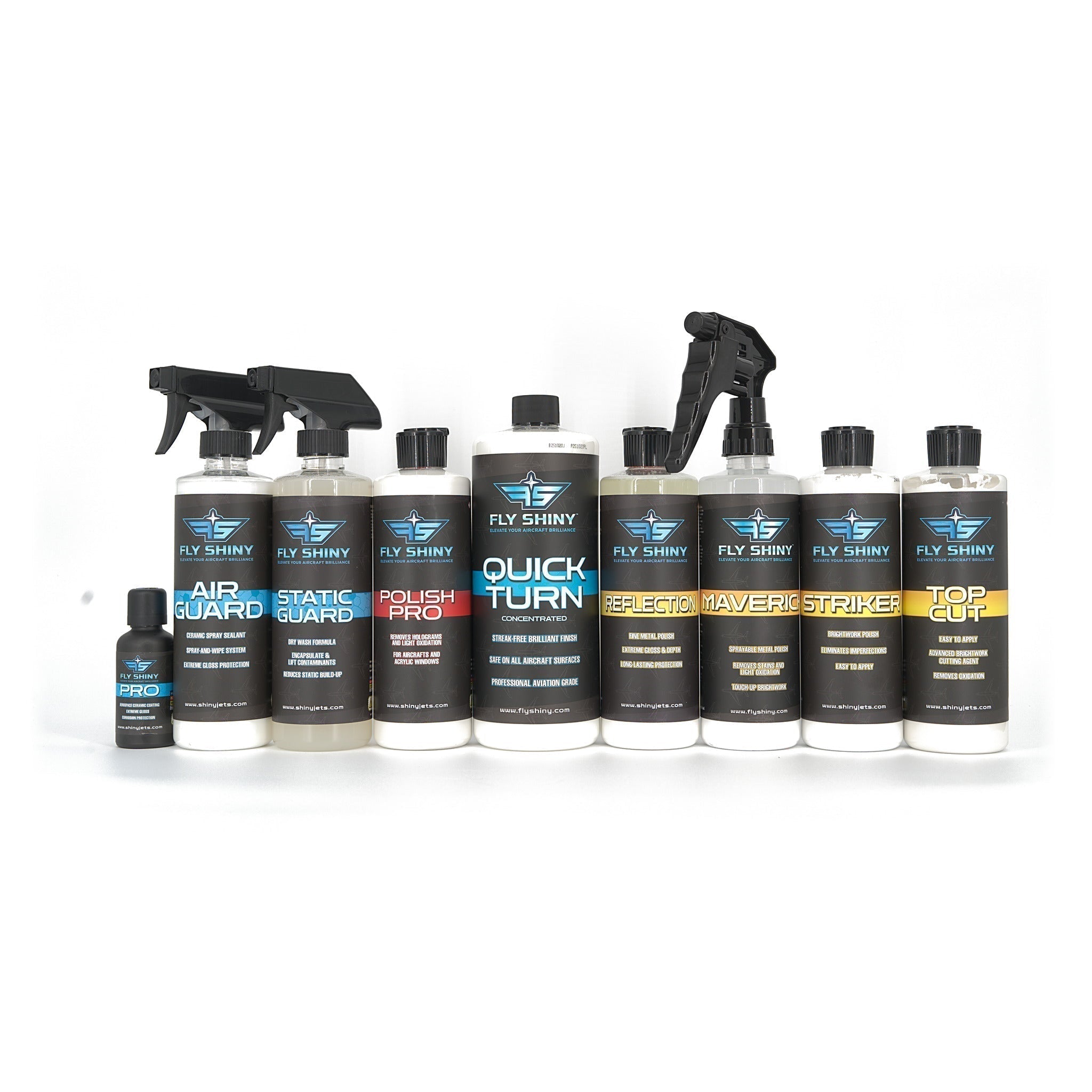
- Fly Shiny Oil Delete — hydraulic fluid and oil on the belly, gear, and engine bottoms
- Fly Shiny Carbon Blitz — thrust reverser and APU soot, gear grime, inspection plate streaks
- Fly Shiny Bug Blitz — bugs on the flaps, leading edges, brightwork, and windshield
- Fly Shiny Maverick — sprayable metal polish for monthly brightwork touch-ups
- Fly Shiny Quick Turn — the dry wash and the neutralizing step for every zone
- Soft brushes for the landing gear, twisted-pile drying towels, a dedicated window towel, disposable terry towels for oil
- Pitot/static covers; inlet and exhaust covers
Before You Start
Walkaround first: document existing damage, look for leaks — find one and you stop and tell the flight department or mechanic before cleaning erases the evidence. Doors closed, pitot probes and static ports covered, covers on.
How to Dry Wash a Gulfstream G550, Step by Step
Step 1: The belly — Oil Delete, then wipe dry
The hydraulic fluid and oil on a G550 belly comes off with Oil Delete alone. Wipe it on with a towel, then follow with a dry microfiber towel — that second dry wipe is what pulls everything up and leaves the belly completely clean. Non-flammable, paint-safe, no harsh solvents.
Step 2: The landing gear — know the rules
The gear gets Carbon Blitz and Oil Delete, applied with brushes and towels. Two hard rules:
Never spray cleaner directly onto the landing gear. Spray your brush or towel, then work the surface. Direct spray puts cleaner where it doesn't belong.
Clean only the painted surfaces. The gear structure and brake assembly's painted surfaces, plus hoses, lines, and fittings — those get cleaned. What never gets touched: the strut (the shiny part) and the gear actuator (the other shiny part that retracts the gear after takeoff). Both carry a film of lubrication from cycling; wipe them dry and you risk damaging the seals and creating a leak. Brake pads don't get cleaned either — nothing belongs on a friction surface. And keep cleaners off the tires: tire manufacturers advise against it.
Step 3: The flaps — in thirds
G550 flaps are big enough to be their own project, so break each one into thirds. Spray Bug Blitz across a third, let it dwell about a minute, wipe, and reapply until that section is clean — the enzymes emulsify the bug remains so they come off without abrasion. Then hit the section with Quick Turn to neutralize before moving to the next third.
Step 4: Under-wing inspection plates
Look under the wings and you'll find streaks trailing from the inspection plates. Clean that staining with Carbon Blitz, then neutralize with Quick Turn. This isn't optional: cleaner residue left on the paint makes it easier for the next round of contaminants to stick — you'd be creating tomorrow's cleaning job today.
Step 5: Engines, thrust reversers, and the APU
Up on the engines: Oil Delete takes the oil off the nacelle bottoms. The exhaust soot on the thrust reversers and around the APU gets Carbon Blitz — no hydrogen embrittlement, no corrosion, no etching — then a Quick Turn wipe to neutralize.
Step 6: Dry wash the aircraft — including the brightwork
Now the full wash: spray Quick Turn section by section and wipe with a twisted-pile towel, working top to bottom. Wherever there are bugs, spray Bug Blitz over the Quick Turn and let it dwell.
The brightwork: here's the good news on those polished leading edges — Bug Blitz doesn't stain brightwork. Spray it on the bugs, just don't let it dry, then come back and wipe with Quick Turn.
And here's how you keep that mirror finish without ever needing a rotary: Fly Shiny Maverick, our sprayable metal polish, is built for touching up Gulfstream brightwork between heavy cutting jobs. A quick Maverick polish every month keeps the aluminum ahead of oxidation — we maintain Gulfstream IVs that have never needed machine polishing or heavy rotary cutting, because the monthly touch-up never lets the brightwork get that far gone. (Full brightwork restoration is a craft big enough for its own guide — coming to this series.)
The windows: the G550 is pressurized, so the windows get cleaned and nothing else — Bug Blitz for bugs on the windshield (never let it dry), Quick Turn to finish, dedicated window towel, wiping with the airflow. No coating of any kind goes on any window.
Final quality-control walkaround, pull every cover, done.
Polishing: If the Paint Is Clear-Coated
Many G550s wear clear coat, and clear coat rewards machine polishing. Fly Shiny Polish Pro pulls light oxidation and enhances the gloss, depth, and clarity of the paint — and it's the step that prepares the surface for protection. The rule never changes: oxidation comes off before protection goes on.
Protecting a G550: Pick Your Cadence
Three options, three maintenance rhythms:
- Fly Shiny Static Guard — the wax. Reapply quarterly.
- Fly Shiny Air Guard — the spray ceramic. Reapply every 6 to 8 months.
- Fly Shiny Pro — the ceramic coating, for the longest-lasting protection.
Here's when the ceramic coating stops being optional: after heavy compounding or restorative paint work. Restored paint deteriorates much faster than fresh paint — without serious protection it can be back to chalky and ugly within 6 to 8 months, and every restoration removes paint you can't get back. A ceramic coating creates a physical barrier between the elements and the paint and extends its life dramatically.
Planning quantities: a Gulfstream G550 takes anywhere from 3 to 6 bottles of Fly Shiny Pro, at roughly 50 mL per bottle, depending on coverage and layers.
Gulfstream G550 Cleaning FAQ
How do you clean Gulfstream landing gear?
Carbon Blitz and Oil Delete sprayed onto brushes and towels — never directly at the gear — working only the painted surfaces of the gear and brake assembly, plus hoses, lines, and fittings. Struts, gear actuators, brake pads, and anything unpainted never get cleaned, and cleaners stay off the tires.
Why can't I wipe the struts or gear actuator?
Those shiny surfaces carry a thin film of lubrication from cycling. Wipe it away and you risk damaging the seals — and causing the hydraulic leak you were trying to clean up after.
Can cleaning products go on the tires?
No. Tire manufacturers advise against cleaners on tires.
Is Bug Blitz safe on Gulfstream brightwork?
Yes — Bug Blitz doesn't stain brightwork. Spray it on the bugs, don't let it dry, and wipe with Quick Turn.
How do I keep Gulfstream brightwork polished without heavy cutting?
Touch it up monthly with Fly Shiny Maverick, our sprayable metal polish. We maintain Gulfstream IVs that have never needed machine polishing or a rotary — a quick monthly Maverick polish keeps the brightwork from ever getting that far.
What removes exhaust soot from thrust reversers?
Fly Shiny Carbon Blitz, followed by a Quick Turn wipe to neutralize. No hydrogen embrittlement, corrosion, or etching.
How much ceramic coating does a Gulfstream G550 take?
3 to 6 bottles of Fly Shiny Pro, at about 50 mL per bottle, depending on coverage and layers.
Why does recently restored paint need a ceramic coating?
Heavily compounded paint deteriorates much faster — it can go chalky again within 6 to 8 months. A ceramic coating puts a physical barrier between the elements and paint that has no margin left for another restoration.
About Fly Shiny: Fly Shiny makes aviation-grade detailing chemicals formulated from 15 years of professional aircraft detailing experience — from piston singles to large-cabin jets. Every product in this guide is available at flyshiny.com. More in this series: Cirrus SR22, Cirrus Vision Jet, Pilatus PC-12, King Air, and Robinson R44 — with more airframes on the way.

Leave a comment
This site is protected by hCaptcha and the hCaptcha Privacy Policy and Terms of Service apply.